
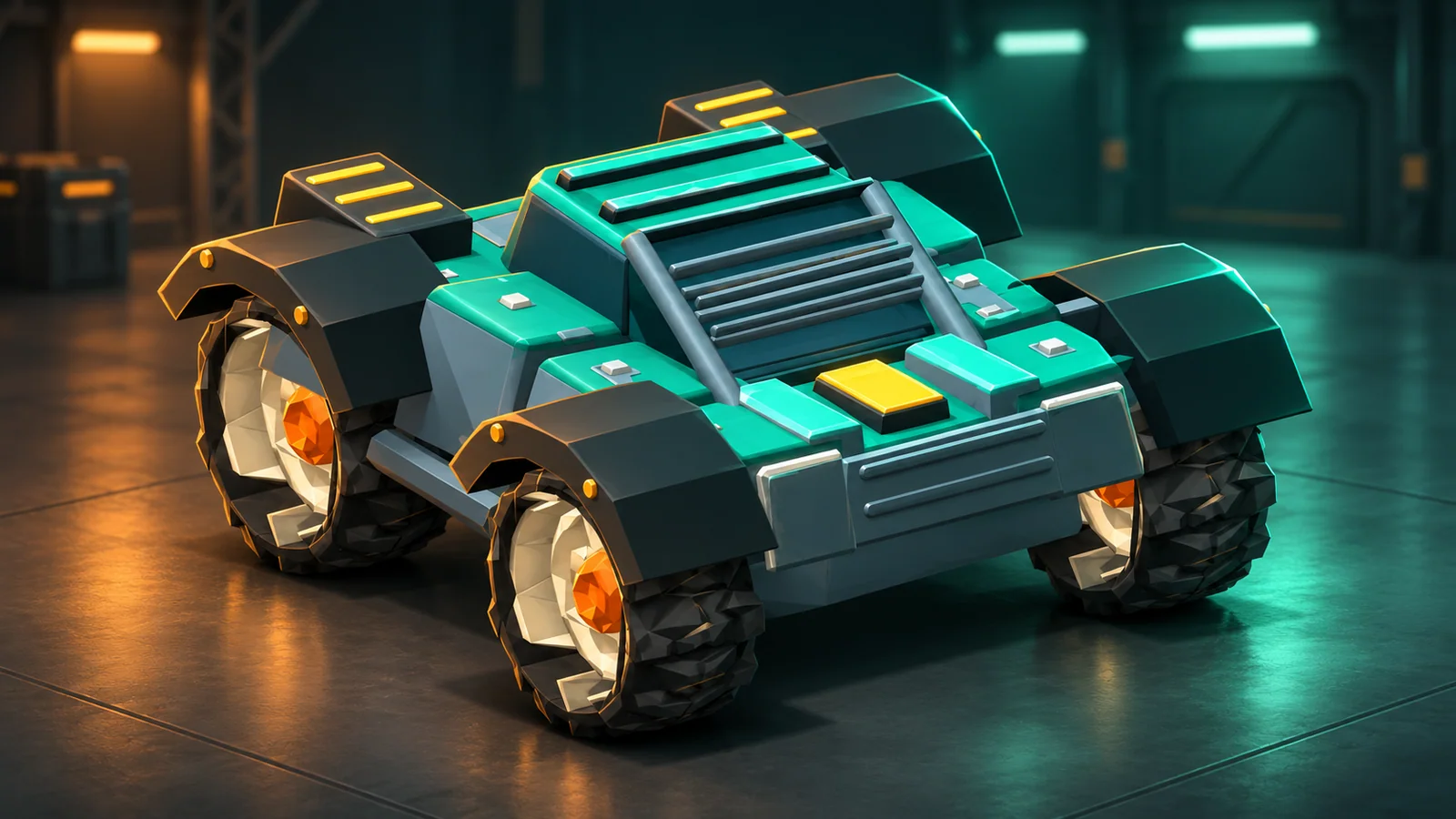
Compare a light spike setup with a three-weapon loadout and see why the same turn needs a different approach after fitting parts.
Weigh a loadout
The base car weighs 24 kilograms before weapons. A spike rack adds five, a disc saw adds seven and a flipper adds nine. Tinker’s starting front rack brings its driving mass to 29 kilograms. With all three weapons fitted the total is 45 kilograms. Extra copies upgrade the weapon on its mount, so a five-copy rack still counts as one rack in that calculation.
Leave room after a fitting
Mass changes how quickly the car builds or sheds speed toward its target. A fully fitted car needs more space to change its motion than a car carrying only the starting rack. Try accelerating down the South Straight before and after fitting a saw and flipper. Begin easing off at the same painted lane mark each time and watch where the car finishes the turn.
Choose the approach that fits
Fitted weapons also project beyond the body and can catch on scenery. With both side mounts occupied, take a wider line past a tank or deck support. The heavier car can carry more momentum into a ram, but a clean approach gives you a better chance of putting that weight against an opponent.
Count the parts actually on the car
Think of the bare chassis as the first item on a scale. It contributes twenty four kilograms before you attach anything. With the five kilogram front rack that Tinker takes onto the grid, the scale would read twenty nine. Collect a saw on an open side and it would read thirty six. Take a flipper in the remaining opening and the total reaches forty five. If you take the flipper before the saw, your intermediate setup weighs thirty eight. The order matters during those laps between pickups, when you may be trying to use a route you learned in the starting car.
You can do the same calculation after replacing a part. Suppose the starting rack and a side saw are fitted, and you select the rack's occupied mount for a new flipper. Subtract the rack's five kilograms and add the flipper's nine. That combination of saw and flipper weighs forty kilograms, even though there are only two weapons aboard. Check the mount cards after driving over the pickup. A matching copy advances the existing weapon, so if the pickup was another saw in this example, the car would keep the rack and saw and still weigh thirty six. Its blade may have improved in the process.
Feel what the extra mass changes
The driving system moves your current motion toward the motion you ask for with the controls. Weight affects how quickly it can make that adjustment. For the starting rack setup the weight factor is twenty nine divided by twenty nine. For all three weapons it is twenty nine divided by forty five, or about sixty four percent of the starting adjustment rate in the same conditions. That difference is easiest to feel when pulling away or changing direction. Given a clear enough straight the heavy setup still aims for the same normal driving speed. The difference builds up during the trip to reach it.
Consider two runs into a turn from the same direction. On the first you are carrying the rack and holding normal throttle. On the second you have filled both side mounts as well. At the same mark you ease off and turn left. Watch the path of the wheels relative to the ground. The body can begin pointing into the bend while the car is still moving outward. A camera that rotates with you can disguise that drift, so choose a fixed mark on the yard and leave your view steady. Start easing off a little earlier on the next heavy run.
Separate weight from width
A fitted weapon occupies physical space outside the car. Swapping the side of a blade changes the clearance you need on each side but leaves the weight of the blade alone. When a car repeatedly catches one particular tank, watch the outside tip of the fitted weapon as you pass. A sudden deflection at the same spot suggests a clearance problem. A wider path around many different bends, even with generous room at the edges, is a better clue to how the car is changing its motion. Try leaving an extra car width beside that tank and see which problem remains.
Armor can complicate the visual comparison. A cyan kit can change the entire body model, and successive bodies change the size of the chassis that can make contact. The driving mass calculation uses the base car and the attached weapons. There is no separate kilogram amount to add for a Roll Cage, Bulwark or Ironclad in this calculation. If you have just collected a kit and the car begins catching in a narrow passage, look at its shape and the weapons you are carrying. The same mass can occupy more space, and an armor change is visible even when the mount cards stay exactly the same.
Give a heavier car room to use its boost
Boost increases the speed the car aims for and increases its ability to build speed. Mass still matters during the boost. A loaded car pointed across a narrow gap cannot make full use of the higher target if the gap ends almost immediately against a rail. Try beginning with the chassis already pointing down an open outer straight. Pick a mark well ahead of the car and compare where you are relative to it when the burst finishes. Use the same stretch and camera for both loadouts. A run that clipped a pickup or another vehicle is a different experiment and worth trying again.
When you head into a crowd, mass also affects the exchange of momentum. A car that took a long run to build speed can push a lighter rival differently from a car that has just pulled away. The shape of the contact still matters. Two weapons can lock and push the cars apart without a damaging body hit. A side impact and a meeting of two noses can produce different hull losses at similar speeds. For a fair comparison, look at how quickly the two cars separated and which faces met. A single knockout tells you very little about the effect of your loadout by itself.
Choose a setup for the route you can drive
A light rack leaves little sticking out on either side and gives a quick response when you change your mind about a lane. Use that opening life to learn the entrance to a ramp or the way around a cluster of tanks. Adding a side saw gives a reason to spend time alongside an opponent. A flipper adds the heaviest individual weapon and can be useful when you get a clear approach. If you intend to keep all three, carry the route knowledge forward with you. Give your car room to finish the turn before lining up the next contact.
One short exercise brings the comparisons together. Choose a bend with a recognisable entrance and an open exit. In the starting setup, enter without boost, release at a road mark and note where the wheels reach the new lane. Once you have another weapon, repeat the same sequence at a similar entry speed. On the third pass move the release point earlier and see whether you recover your original exit. A clear run at each weight teaches you where to make the adjustment during a real fight. The numbers explain the change, and that landmark gives your thumb or steering hand a place to act.