
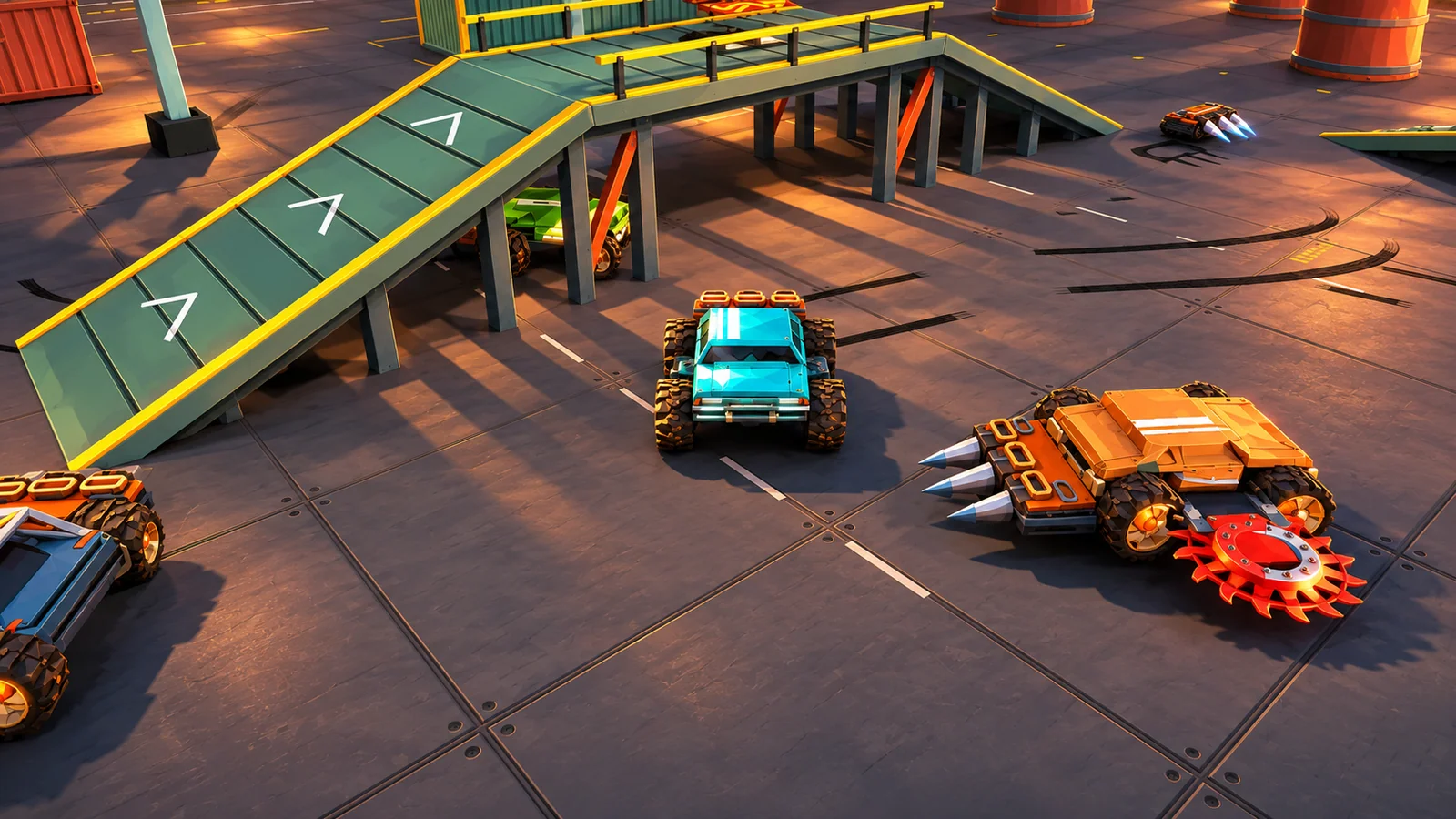
Use floor seams, curved skid marks and a partly hidden car to read motion in Scrapyard Rumble’s Seven rivals still.
Separate the lines on the floor
Look at the open patch of floor to the right of the bridge in Seven rivals. The slab seams meet at corners, and several have round fasteners at their edges. The painted lane markings are white and broken into dashes. Running across both are pairs of dark lines that curve sharply and trail off. Those sweeps are the tyre marks.
The distinctions are particularly clear near the far end of the bridge. A curved mark crosses a straight join between two slabs. Your eye can follow the bend across the join, just as a car could turn across the grid painted on a floor.
Look for the obscured car
Several vehicles occupy different depths in this one scene. The orange car with the red disc takes up a generous part of the lower right. Near the far end of the bridge there is a much smaller dark vehicle. A green car sits between the two in depth, partly hidden by the bridge supports.
The tyre marks pass through the open gaps between those vehicles. There is no need to assign a particular skid to a driver. Following a single arc is enough to imagine the stretch of floor a turning car has just crossed.
Look for pairs across the floor
Start in the open rectangle between the orange rival and the far end of the bridge. Two long black sweeps curve from the middle toward the right. A straight joint between floor panels passes under them. Follow either sweep from left to right, then return along the other one. There is a small interval of bare floor between the two for much of the bend. A pair that can be followed together is good evidence for a turning vehicle. The width of the gap changes as the lines swing across the view, particularly where they head away into the distance.
There is a much shorter group of dark marks beside the small car in the upper right. Viewed close up, these are different shapes from the pair of long arcs. Some turn sharply, some overlap and one extends toward the short white paint marks. For a drawing, give the long pair generous space and put just a few dark accents around the little distant car. Both sets can suggest movement without being the same kind of curve. If you copy every visible mark at equal weight, you lose the impression that one sweep crosses a large patch of floor while the other occupies just a little corner.
Figure out what crosses what
Choose a junction where one of the black lines meets a straight seam. Beside some joins there are two short rows of fasteners with little circles at their ends. The fasteners follow the manufactured panel, even where the two lines seem to meet at a shallow angle. The arc continues onto the next slab with the same direction and width. That continuity is much easier to see near the bright part of the floor than in the long shadows under the raised deck. When the two marks approach the same darkness, change scale and try again with the gallery enlarged.
Now move to the little white dashes behind the turquoise car. A painted dash has a fairly definite beginning and end. Several dashes share a line, with an interval that repeats. A skid tapers irregularly. Its edge can fade before the other member of its pair, and another dark mark may cross it at an unexpected angle. Use those ending shapes to classify any small dark patch that puzzled you in the full view. Sometimes the end falls underneath a car or beyond the edge of the picture. In that case the surviving piece may honestly be too short to support a confident match.
Give a hidden car a footprint
The lime-green vehicle beneath the left half of the crossing is one of the best reasons to enlarge this image. A little roof and part of the nose show through the uprights. An orange diagonal brace cuts across the view, and a dark vertical support conceals another part of the body. Imagine joining the visible pieces with a short dotted line. You can place the car in a fairly small area of the floor without knowing exactly where its hidden wheels sit. The short gap through which you see it says more about distance than the area of green paint alone.
Apply that method to the cropped dark car at the lower left. Part of a large tyre, a strip of body and a row of warm details suggest a vehicle whose centre lies somewhere beyond the picture's edge. Continue its outline lightly in your sketch, then put a question mark where you have had to guess. Compare it with your sketch of the green car. The first disappears beyond the boundary of the image. The second occupies visible space inside the picture but is blocked by other objects. Mixing those two kinds of disappearance is an easy way to accidentally count the same bit of colour twice.
Make a timeline with loose ends
Draw one of the paired arcs on a page, then place a short perpendicular mark near its middle. Treat that mark as the place where an imaginary photograph was taken exactly halfway along the curve. Which way was the vehicle pointing at that moment? A vehicle moving along the curve would be touching a different part of the floor at each end of it. Seen on its own, though, a static curve can be traced in either direction. There is no arrowhead at the end of the tyre mark. Looking past it for other marks and a plausibly placed car can suggest a story without settling it.
That uncertainty is quite productive if you like making storyboards. Draw two tiny follow-up frames for Seven rivals. In one, a car disappears behind the bridge supports. In the other, an unseen car enters from the clear space on the right. Keep the older arc in the same place in both frames. Notice how little of your interpretation depends on exactly which car made it. The curve already establishes that the open floor can be crossed on a sweeping line. The visible drivers and their different positions supply plenty of possibilities for a next event without requiring a precise reconstruction of the last one.
Try the floor without the vehicles
A simple last exercise is to cover the orange rival and the turquoise car with two small pieces of paper. Plenty of the scene remains legible. The yellow rim of the bridge rises on the left. Rectangular slabs extend across the lower half. The twin curves on the right draw your gaze back toward the supports even when there is no longer a brightly coloured vehicle at their end. If you copy just the uncovered pieces, another reader may still identify this as the derby scene rather than the empty yard overview.
Bring the turquoise car back first. Its wheels sit just in front of a break in a white lane marking and give the surrounding arcs a rough sense of scale. Return the orange car and the red disc adds a new circular shape, this time solid and textured with teeth. Look once more at the dark tracks beside it. They belong on the surface behind and around the vehicle, while the disc projects out from its side. That last distinction between a curve on the ground and a round object above it is easy to miss in a thumbnail and rewarding to catch in the full picture.