
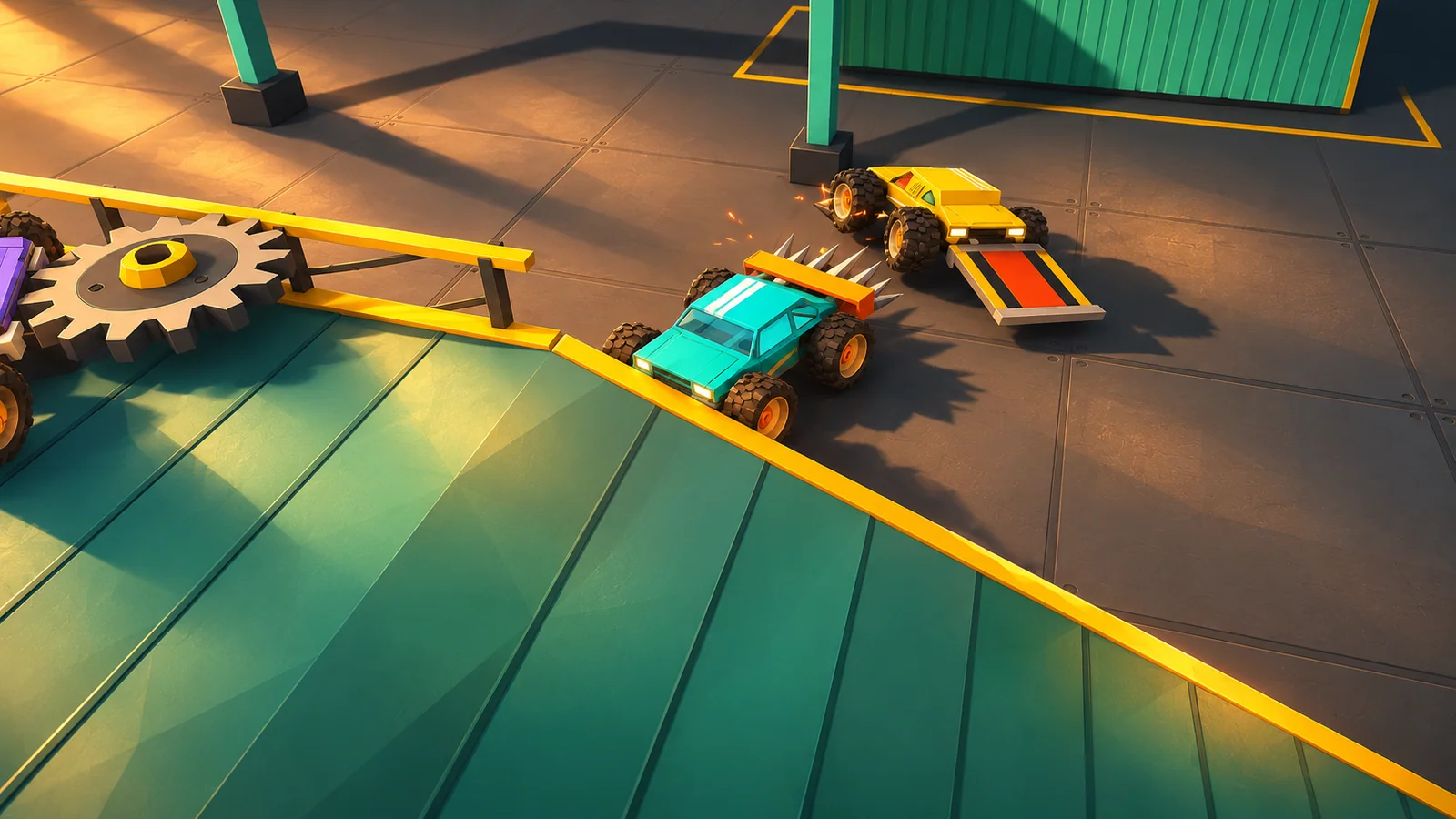
A cropped purple car, a toothed disc and a diagonal ramp give the Broadside at the ramp still its sense of movement.
Count the cars
Two cars are easy to pick out in Broadside at the ramp. The turquoise one has white stripes and sits close to the lower rail. Behind it is a yellow car with a striped plate extending from one end. A third vehicle barely makes it into the picture. Look at the far left for a sliver of purple bodywork, a tyre and part of a large toothed disc.
That crop lets the disc loom over the ramp. If you tried to fit the whole purple car in a shot of this width, the two cars at the centre would have to become much smaller.
Follow the yellow edge
The ramp cuts across the lower half of the picture. Its yellow rim briefly hides the front of the turquoise car, which puts the ramp closer to us than the car. Farther back, small orange sparks near the yellow car's wheel give your eye a precise place to look among all those bright body panels.
Cover the sparks with a fingertip and the scene still feels crowded. Cover the cropped wheel and disc and the left side goes quiet. Most of the impression of a larger melee comes from that small fragment entering the frame.
Mark the corners before the cars
A helpful way to study the collision picture is to sketch its corners first. The lower left belongs to the painted deck of the ramp. The lower right also contains a piece of that green surface, narrowing under the long yellow line that cuts down to the corner. At the upper right a corrugated container fills much of the edge. At the upper left warm light falls across a comparatively empty patch of floor. You have just placed two large green shapes at very different distances without drawing a single wheel. Leave a strip of open floor between them. That strip is where most of the encounter has to fit.
Now put a small turquoise rectangle close to the rim of the near ramp and a yellow one above and to its right. Even if you stop there, the space around the two rectangles has some tension. There is much more room on the far side of the yellow shape than there is between the turquoise shape and the ramp. When you look back at the actual cars, you can see how their positions make a very specific story possible. The foreground structure has already closed off part of the space one of them occupies.
Reconstruct the purple fragment
The left edge is an interesting exercise in how little of an object has to be on screen. Look first at the large pale toothed disc. Its centre is yellow, with a dark opening. Below it, near the edge, is a short length of exposed wheel with an orange hub. Above and just beside it are a few strips of purple bodywork. The three clues belong to different sorts of surfaces. One is a piece of flat metal with a repeating outline, another is deeply textured rubber and the last is a smooth painted panel. The tyre and the body in particular make the vehicle recognisable.
Conceal one clue at a time with a narrow scrap of paper. With only the toothed shape visible, its relationship to the ramp becomes uncertain. It could be resting on the deck. With the wheel and purple panel visible together, it becomes much easier to picture a vehicle extending a little beyond the edge. You can try the reverse exercise on the yellow car. Crop away everything except the front of its striped plate and a piece of wheel. Which remaining fragment identifies the body colour, and which only tells you there is an attachment? The comparison shows exactly how precisely the real crop on the left is balanced.
Distinguish painted yellow from showering sparks
In this picture yellow can mean quite a few things. The rail has a nearly continuous strip of it, interrupted where the edge changes direction or meets a support. The yellow vehicle has broad panels that turn into warmer shades around its creases. A painted rectangle on the distant ground describes where the green container sits. The little sparks near the wheel spread out in brief strokes, each divided from the next by open space. When you enlarge the still, follow each type of yellow to its end. Most of the solid yellow objects meet a neatly defined corner. The tips of the sparks fade into the warm floor.
The floor directly behind the yellow vehicle is particularly useful for this comparison. Its seams are straight and quite dark. The brightest sparks cut across that regular surface at several different angles. Look down at the tyre nearest the little cluster of marks and you can place the activity much more precisely within the cluster of cars. In a simplified redraw, keep three or four of those marks and set them against a quiet patch of floor. Filling the whole gap with orange strokes would give an entirely different impression of the scale of this moment.
Read the overlap along the ramp
The long yellow rim gives you a reliable line for sorting the different depths. Start at the left, where there is a raised guardrail. Follow the rail above its dark support until it ends. Lower down, the edge painted along the deck continues farther, passing in front of the turquoise car and dropping toward the right corner. These are two different lines, visible at two different heights. Get them confused in a sketch and it starts to look as if the yellow rail goes right through the bonnet. Follow them separately and the car sits quite convincingly behind the green foreground.
The same trick works around the yellow car's projecting plate. A dark shadow falls beside that plate, shaped differently from the tyre shadow nearby. The stripe on the plate is clear enough to follow to its silver-coloured end. Its edge is free against the floor, so the plate reads as an object extending beyond the rest of the vehicle. These two examples make an instructive pair. One body part disappears behind an obstruction. Another projects into a clear area. Between them they give the shot a surprising amount of depth for a scene concentrated largely on a patch of flat paving.
Try a square crop of the same moment
Hold two pieces of paper against the enlarged still to make a square around the turquoise and yellow cars. Keep those cars just as large as they were in the full image. You will probably lose much of the purple vehicle and a long piece of the ramp. Ask someone who has only seen your crop to count the cars or describe where they think the space continues. Then move one piece of paper just far enough to reveal the purple panel and the wheel. That small change supplies evidence for an entirely new participant in the picture.
A second crop is worth testing over the distant container and the wheels under it. It has plenty of industrial character, including the strong vertical ridges and painted bay on the ground. It gives hardly any information about the shape of the ramp. A third crop centred on the rim does almost the opposite. After you restore the full image, look at the path your eye takes between these patches. A collision that initially seems to occupy one small point is assembled from evidence distributed right across the width. The people studying the crop may agree on the cars involved and still disagree on which piece of the scene they noticed first.