
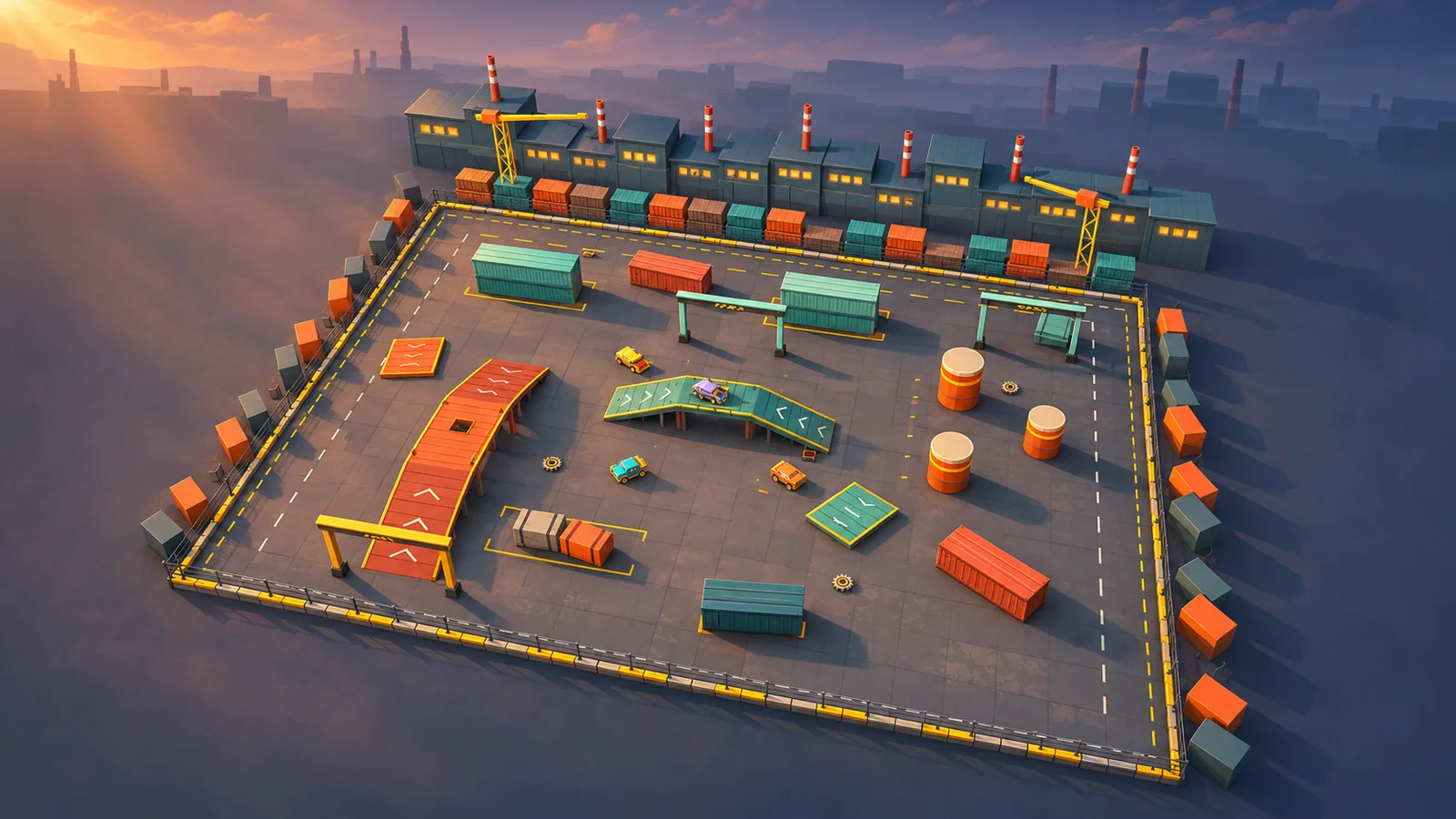
Match the bridge in the aerial view of Scrapyard Rumble to the one in Seven rivals using the deck, painted arrows and supports.
Pick a shape from above
Halfway across the Ironworks Yard overview is a green bridge with a small car on its crest. The yard contains several ramps. This one has a slope at each end, a short raised deck in the middle, white arrowheads on the surface and yellow paint along the edges. The long red structure farther left makes a useful second landmark if you lose your place.
From this height the bridge looks remarkably slight. A strip of dark shadow below its deck and the thin supports along its edge are the first hints of how much room there is underneath.
Drop to car height
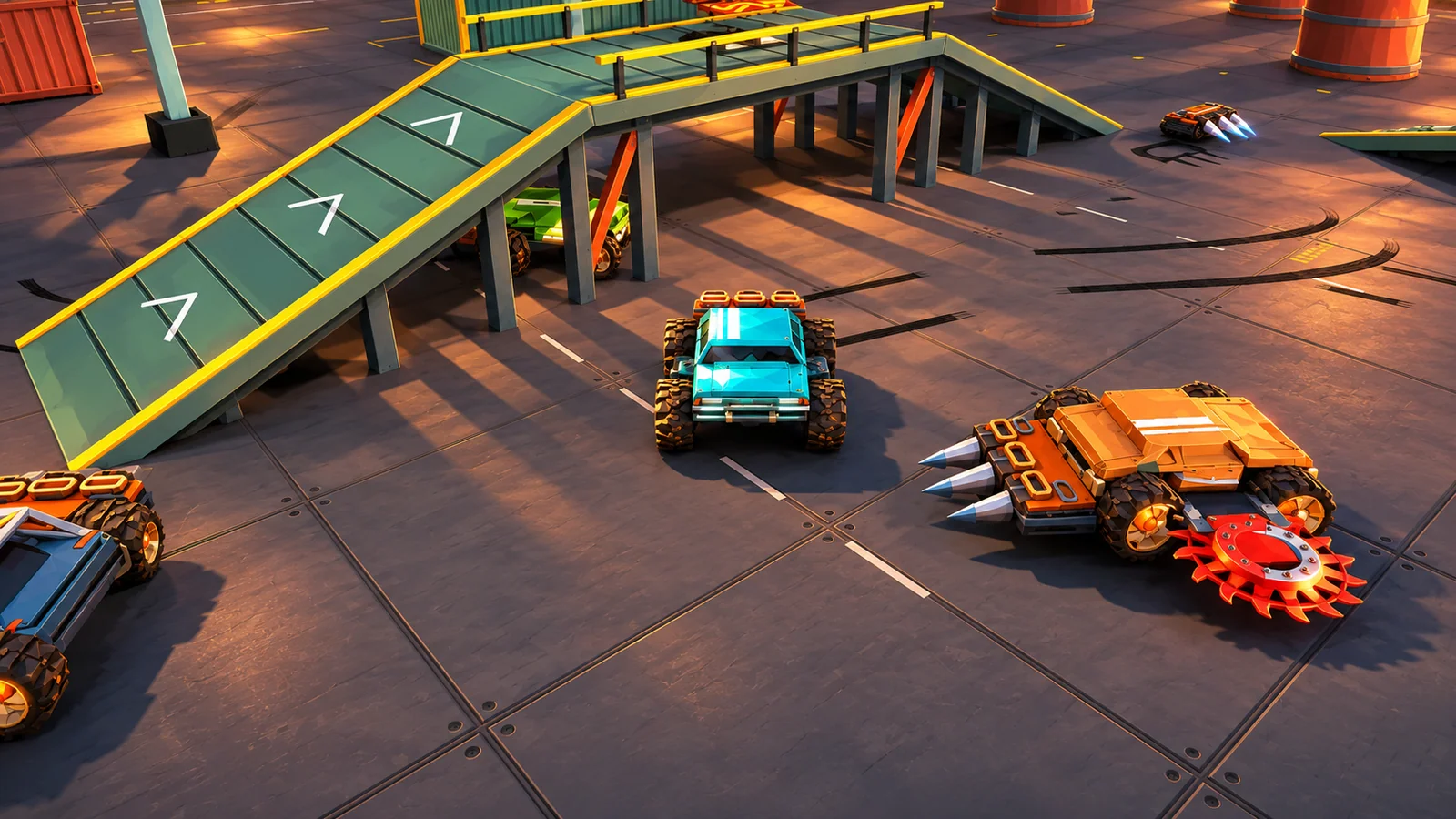
Move to Seven rivals and start at the left edge of the picture. Follow the row of white arrowheads up the green slope. The yellow trim continues across the raised middle before dropping away on the far side. Three matching features are enough to recognise the bridge after the change of angle.
The black uprights now fill much of the space behind the turquoise car. Part of a green car is visible between them. Switching back to the overview with that car in mind gives a much better sense of the scale of the crossing.
Make a list of likely matches
The arena overview gives you several candidates for the bridge before you ever switch to the closer scene. There is the broad red ramp to the left, a smaller orange ramp beyond it and a small green ramp on its own in the lower right part of the yard. All of them have white surface markings and several have yellow trim. If you carry only those two clues into the next slide, almost any candidate could win. A better list also includes the direction of the slope, whether the middle is raised, and whether a vehicle could be partly hidden by the visible structure.
Inspect the green object near the middle, starting at its left end. Its approach meets the floor, rises to a section carrying a small purple car, then falls again toward the other side. Under the raised surface are thin upright supports. The small green piece near the lower right has a much shorter footprint and a simpler outline. The red ramp has a distinctive opening cut out of its deck. Add just these differences to your list and the next image becomes quite a good matching puzzle. A specific structural clue is more useful here than the repeated industrial paint scheme.
Trace the approach from the floor up
In Seven rivals, the green approach begins at the left edge, near the lower half of the frame. Its side runs at an angle toward the upper middle where the slope changes to a level section. The white marks sit one per broad section of green surface, and their tips lead your eye uphill. Yellow edges keep the two sides of the approach easy to distinguish. Near the crest, the yellow line is joined by another at a different height, with dark posts linking it to the deck. That change helps separate the railing along the raised section from a line painted onto the surface.
Go back to the overview and put your attention on the little green bridge instead of taking in the whole yard again. The compact patch carrying a purple car now has a small rise, a middle and a far slope you can identify in order. The purple car is useful for finding the right object in this view. It is the sequence of parts underneath the car that identifies the structure across the two pictures. This distinction is helpful with any pair of arena stills. A vehicle can occupy a different patch of the scene while the identifying features of the bridge stay visible.
Turn the shadow into a side view
From far overhead the view under the bridge is compressed into a dark strip. Look for the little upright lines that interrupt it. In the close view, each upright becomes a substantial support planted on the floor. The warm light reaches into the gaps between them, breaking the shadow into alternating strips of shade and exposed concrete. Two orange braces cut diagonally through those gaps. Follow a brace upward and you can see roughly where the road surface passes overhead. Follow it downward and it ends close to where a car's tyres would sit on the yard floor.
One way to make sense of this arrangement is to draw a side elevation in three strokes. Start with a long floor line. Draw a shorter line above it for the raised deck. Connect their ends with slopes and mark where the columns stand. The close view supplies the height that was hard to estimate from above. Now draw a second diagram looking straight down. The width is much easier to infer from the overview, where you can see the car on the crest and the yellow edges on either side. Neither of these drawings needs exact measurements. Together they explain why the same bridge occupies so much more of the foreground in one picture.
Keep the cars as scale references
There is a rather useful sequence of car sizes in the two stills. In the arena view, even the car sitting on top of the crossing fits easily between its edges. Elsewhere in the yard small cars share the floor with shipping containers and drums that appear much longer or taller. In Seven rivals the turquoise car near the middle takes up a large portion of the span between the near support and the right slope as you see it on the screen. A green car farther back peeks out through a gap between supports. The change in apparent size tells you how far you have come into the scene.
It is worth doing a little sanity check before estimating a width. The turquoise car projects across part of the bridge in the picture but sits on floor closer to the viewer. Measuring its screen width directly against a distant part of the deck will exaggerate how much space it takes up there. The small car actually sitting on the bridge in the overview gives you a more convincing comparison for the width at the crest. The hidden green car provides a different kind of evidence. You can plainly see some of its roof through a gap under the deck, which tells you something about the vertical opening.
Make directions work from either photograph
Write a one-sentence clue to this bridge without using left, right, near or far. Something like “Find the green crossing with two sloped ends and white marks rising to a level deck” gets remarkably close. Now show it alongside both stills. The high view lets someone test the part about two ends. The low view makes the posts beneath the level deck much easier to confirm. If you have room for one more detail, mention the yellow edges and invite the reader to follow one continuous line from the surface up to the crest.
There is room for a more difficult version of the puzzle in the margins. Find one detail in each photo that would make a bad instruction for matching the pictures. The purple car on the crest is a good candidate in the overview. The bright red side disc of an orange car might catch your attention first in the closer view. Both are memorable and precisely drawn. Neither describes the bridge. Sorting temporary neighbours from structural landmarks is the reason this pair makes such an effective little exercise in reading a game environment from two different heights.