
Trace a road through Fernwood Reach and a lap around Ironworks Yard to see how each game gives the eye a place to start.
Three roads to the Heart
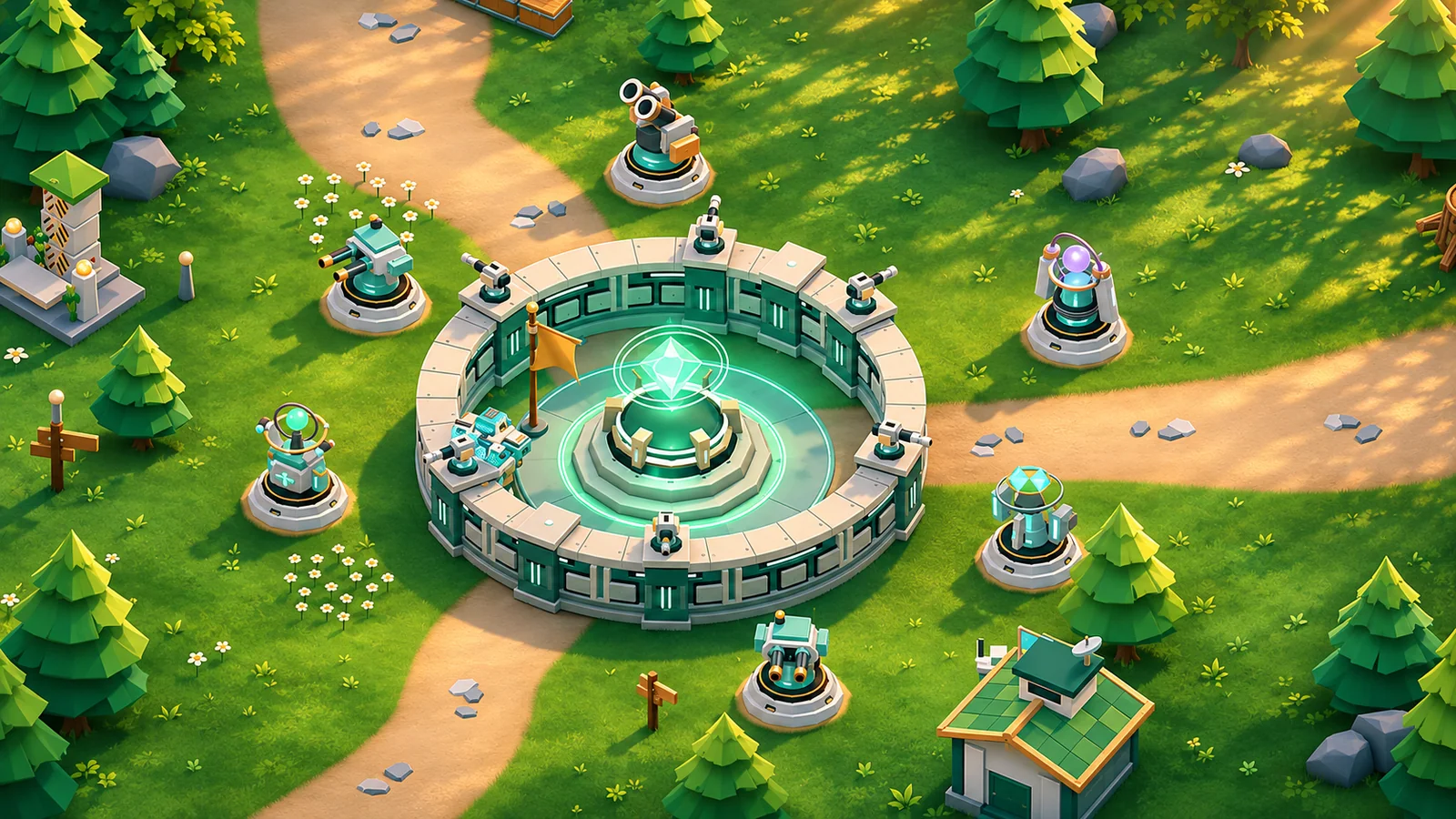
Start in the lower left of the Fernwood Reach still and follow the sandy road past the wooden sign. It meets the near wall of a round fort. Look across the fort and you can pick up two more stretches of road, one bending into the trees at the top and another leaving on the right. A viewer who starts at any of those edges ends up looking at the Heart.
The outpost is easy to remember as a handful of shapes. A bright diamond floats inside a ring, and a larger stone ring encloses them both. The little towers sit on round bases of their own.
A lap around the yard
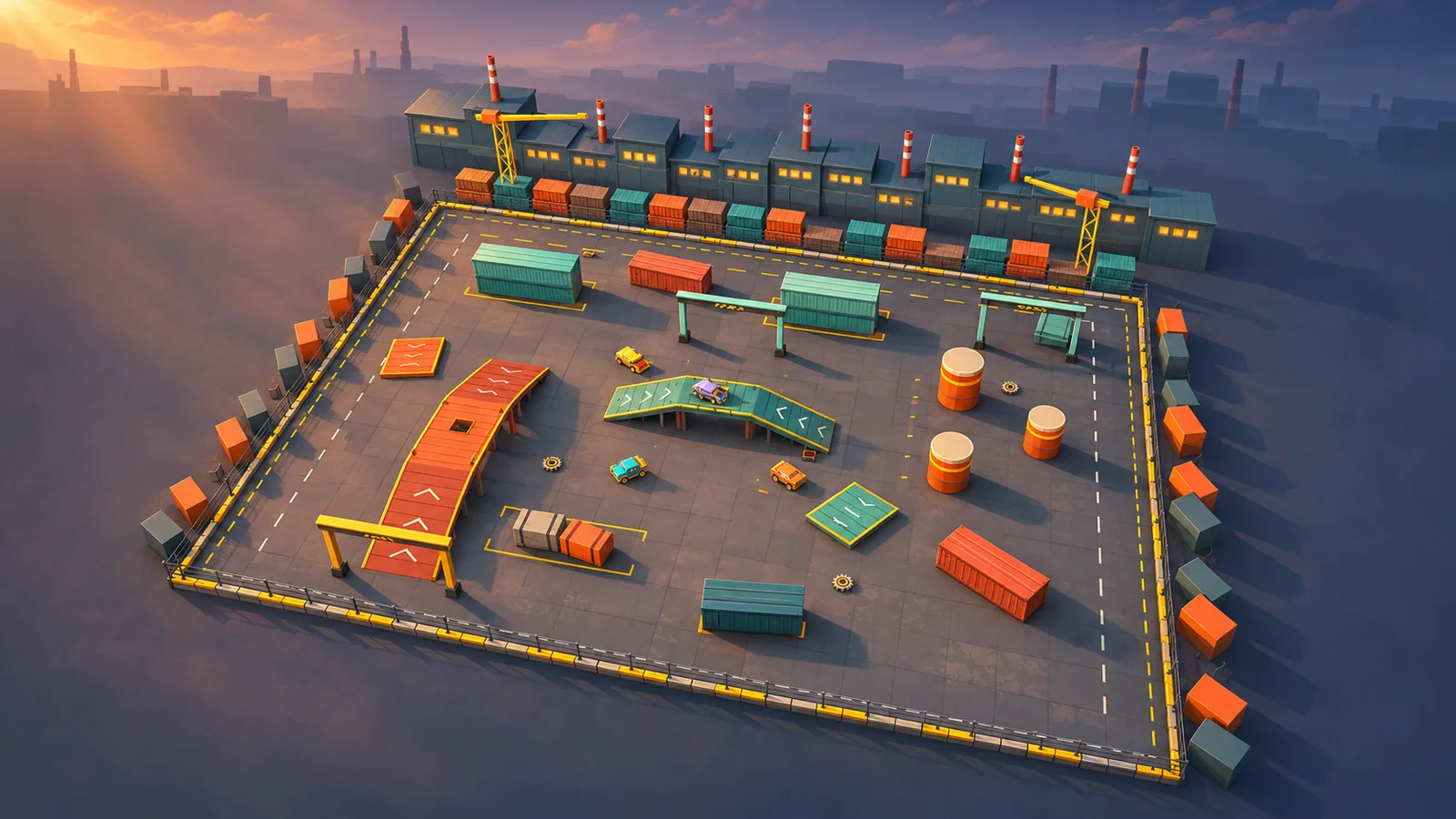
Switch to the Ironworks Yard slide in Scrapyard Rumble. The easiest line to follow there runs all the way around the outside, past the factory buildings and along the barrier at the front. The centre has several possible landmarks. Try the red ramp on the left, then find the short green bridge and the three drums on the right. You can describe a trip between those three in a sentence. That is a useful test of how well an arena overview gives you your bearings.
Give the fort a front door
There is no large arrow stamped on the Fernwood picture to tell you which way up your mental map should go. You can supply one by choosing a detail that appears only once. Try the small building in the lower right corner. Its green tiled roof has a raised white section and a little dish. Find the yellow flag inside the fort, then the tower with two large barrel openings near the top. Those three details make a crooked triangle. Turn away, put three dots on a scrap of paper and name them again. You now have a way to recover the orientation of any smaller piece of the picture.
The test gets interesting when the roofs and flags get cropped away. Picture a close view containing only the pale road, a few stones and some grass. Very similar pieces exist on more than one side of the fort. Now add the daisies just outside one stretch of wall, or a glimpse of a signpost. The road becomes much easier to place. A useful direction joins a repeated feature to a distinctive neighbour. “The path below the flag, beside the patch of white flowers” gets someone to a much smaller area than “the path by the wall.”
Decide which way to read the yard
You can play the same orientation game in Ironworks, although its rectangular outline creates a different problem. Rotate a rectangle half a turn on a sheet of paper and its outline looks identical. The two ends of this yard are easy to tell apart once you include something outside the fence. Along the distant side stands a row of factory roofs with lit windows and tall striped stacks. The near side has a low barrier, with the ground beyond it disappearing into haze. Even a black and white sketch can retain the difference between those two edges.
For directions inside the yard, give those edges names. Call one the factory side and the opposite one the near rail. Place the three large orange drums together toward one short end. Along the other short end draw the long red ramp with the little square opening in its deck. This gives you four quite different boundaries to work with. If you point a friend toward the drums, then ask them to look beyond the drums toward the factory, they can land on the containers along that side without having to decide whose left you mean. Words anchored to visible scenery survive a change of viewpoint surprisingly well.
Draw the empty routes first
For a second sketch, leave all the Fernwood buildings off the paper. Draw just the light strips of ground that you can see. A broad strip enters from high on the left, narrows near the round wall and disappears behind it. Another emerges to the right. The third emerges below and turns toward the lower left corner. Leave a blank patch for the fort. It is helpful to stop your pencil where the surface vanishes behind stone. Extending the pencil all the way through the fort would quietly turn a view from above into a claim about a road you cannot see.
Repeat the exercise in Ironworks using only the gaps between large objects. There is a generous clear patch near the lower rail, between the long red structure and the separate green ramp. Elsewhere the gaps pinch down between pieces of scenery. There are many plausible lines through these spaces, and the white lines on the floor mark only some of them. This is a sketch of how open the pictured floor looks. Two people can produce different lines and both accurately capture the view. Compare the sizes of the spaces you drew before comparing which way your lines turn.
Find a place from a description
Here are two small navigation puzzles to try with the galleries open. In Fernwood, start at the tower with the purple sphere. Go straight toward the round outpost and stop just before its outer edge. Which part of the fort are you looking at? The answer is on the upper right curve, where a little barrel projects over the pale stone cap. If you ended up by the flag, check whether you started at the purple sphere or at the other round-topped tower across the fort. Several objects share a general shape, but their colours separate them.
In Ironworks, start at the row of drums and look across the green bridge toward the tall red ramp. Look down into the gap between those two structures. There is a small toothed shape lying on the floor there. A second such shape sits much nearer the front rail, beside the separate green ramp. Describing either one as a gear on the ground leaves two candidates, even before you inspect the rest of the yard. Adding which structures enclose it resolves the ambiguity. This exercise works particularly well with the gallery enlarged, where the small shapes hold up when you go looking for them.
Check what your sketch remembers
A good way to finish the two sketches is to move them out of sight for a minute. Open the games page again, glance at each still, and redraw only enough for someone else to identify it. For Fernwood you might need just a bright centre and several paths coming toward a ring. For Ironworks you might need a factory edge, a long red ramp on one side and the little crossing near the middle. Compare those quick drawings with the detailed ones. Which of the first marks would you keep if you could add only one more?
There is a practical payoff when viewing the rest of the gallery. The bare outline of the round fort can help you identify it under snow or in the volcanic scene, where the surrounding ground changes dramatically. The arena crossing is recognisable even when the camera comes down close enough for the green slope to cut across most of the picture. A remembered shape gets you started. A second, well-chosen detail confirms where you are. Try giving each picture a two-detail description that another person could recognise with the title covered.
For a final challenge, hand over the sketch upside down. Ask which landmark gives away the rotation first. A flag, a factory skyline or an unusually shaped ramp makes a better compass than an unmarked stretch of road.