
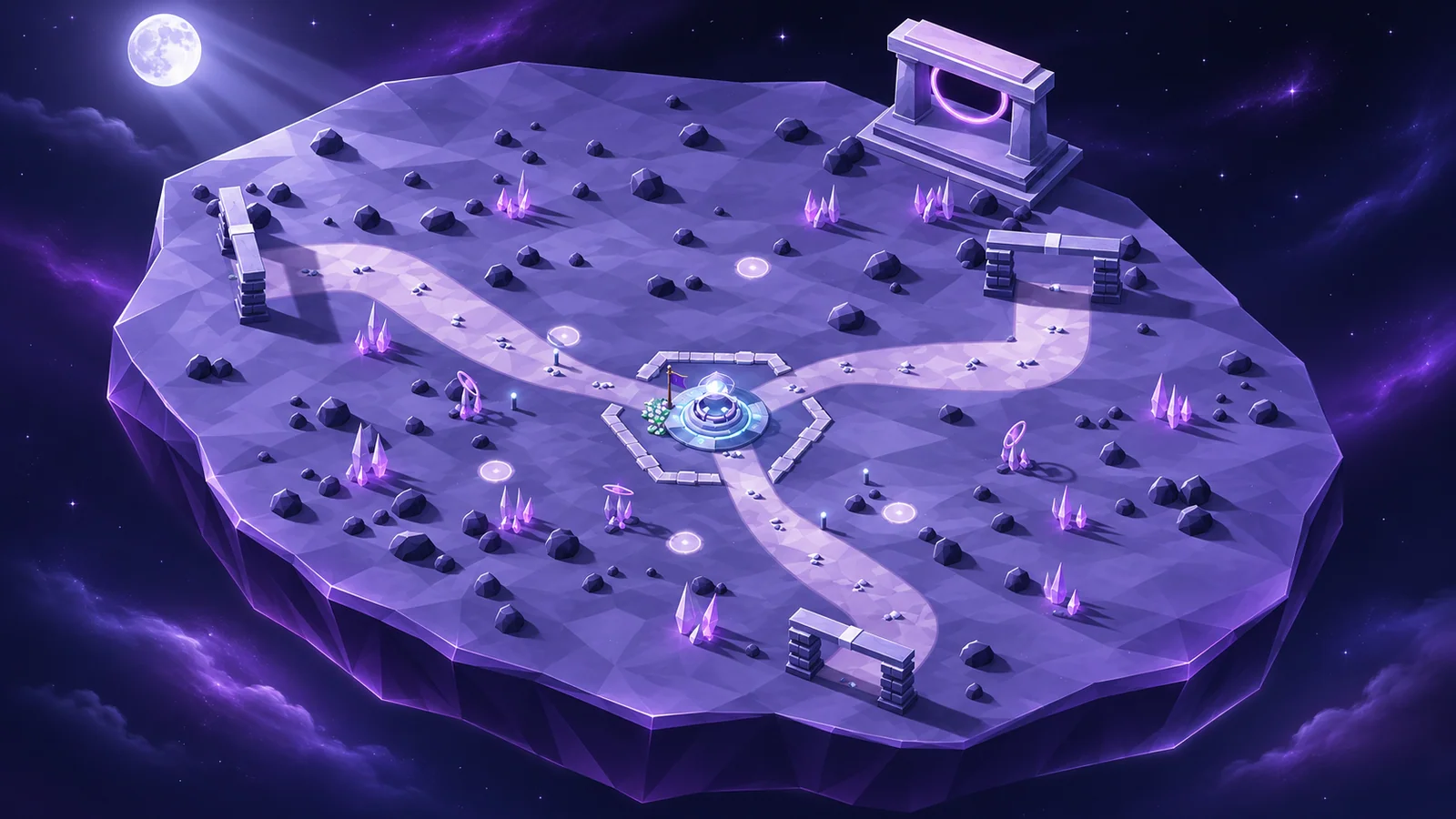
Follow three pale paths across Verdant’s floating island and pick out the monumental arch that stands apart.
Start inside the walls
The largest gateway in the Astral Citadel still stands at the back of the island, with a luminous violet arc suspended between its pillars. It is a tempting place to begin tracing a route. For a clearer picture of the layout, begin at the small blue Heart instead.
Three breaks interrupt the low wall around it. The pale path through the lower break bends toward a lintel near the front edge of the island. Another arm turns left and reaches a doorway seen almost edge-on. Follow the right-hand arm and it bends toward a third stone frame below the big monument. Each branch has small stones scattered along it.
Read the empty space
There is open violet ground between the monumental arch and that right-hand path. A cluster of crystals occupies some of the gap. Enlarge the still and you can see the separation particularly clearly where the steps at the base of the monument cast their shadow.
You can sketch this island from memory with just a three-way junction and four doorways. Add the moon at the upper left to keep the sketch the right way round.
Give each doorway an address
The four doorways in the Astral scene occupy four quite different positions relative to the island. One sits very close to the left outline, set at such an angle that its beam looks short. One stands at the lower end of the broad pale path and shows most of its front. Across on the right, another is visible just below the raised monument. The fourth is that monument itself, with steps below it and an arc hanging beneath the beam. Write one positional clue and one visual clue for each. You now have four useful names even if you never learn any terms beyond those in the gallery.
Test the names with the island rotated in your imagination. “Lower doorway” stops being very helpful. “Wide opening at the end of the road from the nearest break in the wall” still points to a particular structure. The left-hand doorway is trickier because its opening is foreshortened. Look for the line of stacked blocks on its near support. The bright top of the lintel and the darker face below form a narrow vertical stripe in the picture. Once you have seen that shape as a doorway turned away from you, its relationship to the curved stretch of path is much easier to remember.
See a fork in a pale surface
The tracks immediately around the Heart are worth tracing on their own. Colour is a stronger clue than a hard outline. The road is pale lavender, and the surrounding island breaks into larger, slightly darker triangular planes. Some of those planes are surprisingly close to the colour of the road. To keep the two apart, pick a point where a small rock sits on the path and look sideways from that point. The road keeps a fairly regular width around the bend. The neighbouring planes change width and direction as their edges meet.
At the bottom, the track almost disappears behind the central apparatus before coming out through the opening in the low wall. Along the left arm, its sweep is broad enough that you can follow both edges together as it passes between dark rocks. The right arm makes a more abrupt turn before it reaches the doorway. Draw these three turns in order, giving each just one stroke. Add the walls and doorways afterwards. If you add all the glowing circles and crystals at the same time, it is easy to connect two bright spots into a route simply because they line up. The continuous band of pale ground is much better evidence.
Count the circles carefully
Several different things make circular marks on this island. There are thin white circles lying close to the ground, often with a little symbol near their centres. Other rings appear to sit at a slant, alongside upright crystalline forms that cast distinct dark shapes beside them. The luminous arc at the monument is held clear of the steps. Inside the Heart, a set of curved lines encloses a much smaller luminous object. Naming every one of these as a portal would conceal the differences you can actually see in the still.
Try sorting them by the angle at which their circles appear. The marks lying low look broad from side to side and shallow from top to bottom. The ring near the small crystal formation at the middle right rises almost vertically from the surface. A longer, darker loop falls away beside it. The big arc in the monument sits over an opening through which you can see dark sky. Look for that opening before comparing the glow colours. A little space visible inside a ring tells you a great deal about where it sits. An observed shape like this can stay in your notes even when its purpose in the game is unknown.
Use the sky to outline the island
Most of the Verdant gallery frames crop away the edge of the world. Here you can follow the near side of the island almost all the way around. A narrow lilac line catches the light along its rim. Below it are dark angular faces dropping into a field of stars and cloud. Pause at the point where the lower doorway approaches that rim. The end of the pale road and the visible thickness of the island share a small area of the picture. If you draw only the road, it looks as though the view might continue indefinitely. Adding two lines for the rim makes the little gate feel close to an actual edge.
The moon provides another useful reference above the far left side. Its outline is almost perfectly round. Beneath it, the island outline changes direction in a sequence of straight segments, and the road bends more softly than either. These three shapes are quite distinct even when the blue and lavender colours merge on a dim screen. Trace just the sky between the moon and the near edge of the island in the upper left corner. The beam and supports of that edge-on doorway become surprisingly clear once you look at the shape of the open sky behind them.
Test the map against the picture
Lay out six simple marks on paper, a dot for the Heart, three strokes for the branches and two small boxes for any two doorways you choose. Pass it to someone with the still open and ask them to finish the other two. A good clue is the dark mass of the monument's steps above the right-hand roadway. Another is the moon. Those give the two readers a common orientation. Then see whether either person has accidentally put the large monument at the end of the right-hand branch, an easy mistake if the diagram turns into a list of memorable features.
A useful second check is to mark something that definitely stands between two other things. A patch of ground studded with crystalline points separates the base of the large monument from the nearest road and doorway. Give that little interval its own space on the sketch. The distance may be small on paper, but it preserves the most surprising distinction in the image. A dominant landmark can tell you where you are in the wider landscape even when the route you are following ends somewhere else.