
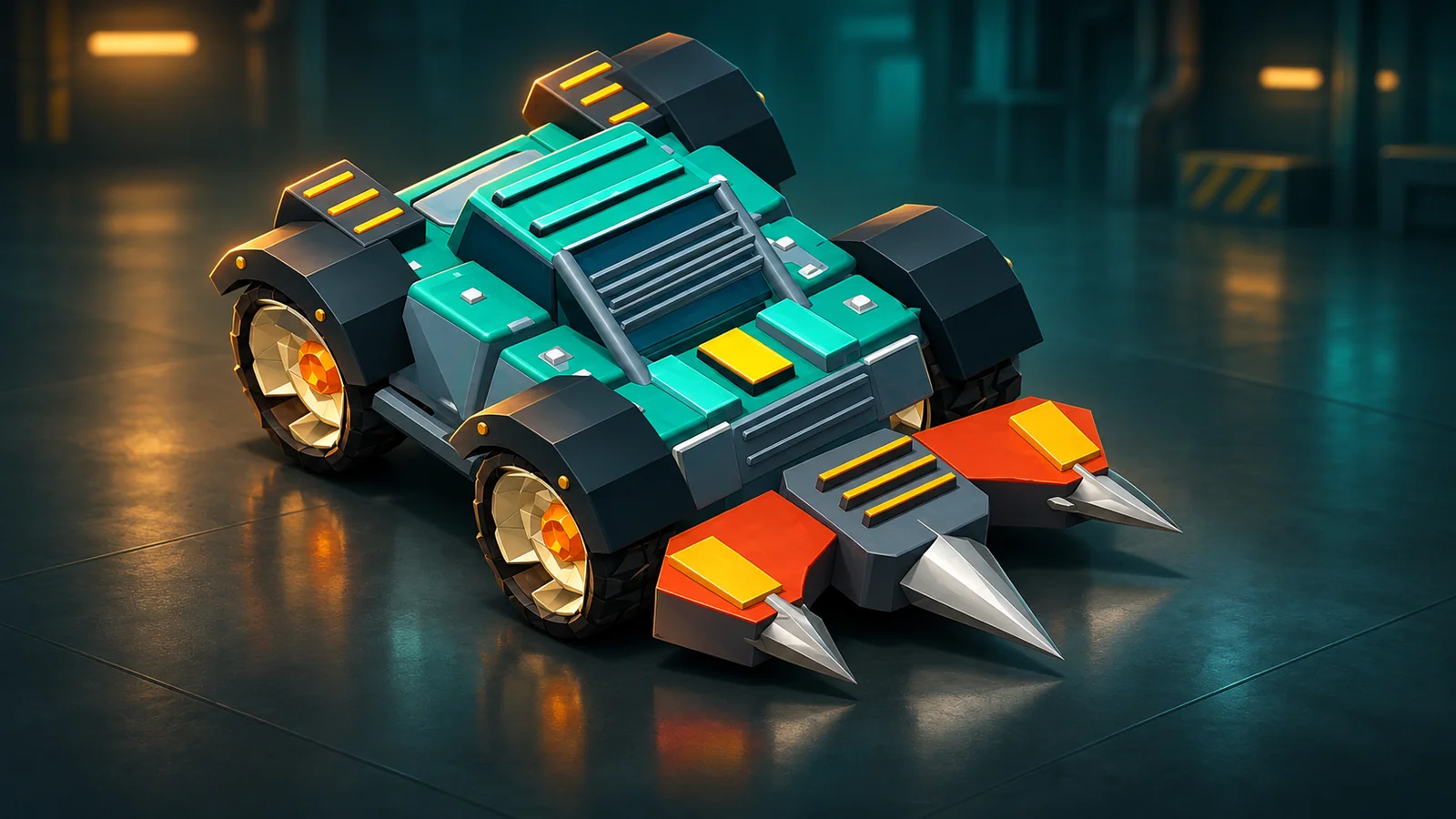
Read the tier card and decide whether a matching pickup will unlock an upgrade, re-equip a lost part or leave it at maximum.
Count each weapon separately
Spikes, saws and flippers each have a separate total. The first copy fits the base weapon. The second, fifth and tenth copies unlock its next three tiers. These are total copies collected in the current heat. If your mount card reads 4/5, one more pickup of that kind gives you the third tier. Taking a different weapon leaves that progress alone.
Use the mount card to plan a detour
Look at both the weapon name and the fraction under it. At 1/2 the nearest matching pickup has an immediate payoff. At 5/10 you have just reached a milestone and still need five more for the final upgrade. Gold radar marks cover every weapon type. Check the loose model when you get close enough to see whether the trip advances the card you care about.
Carry progress through a wreck
If a weapon falls off the car in a knockout, its count survives. Collect that kind again to fit the upgraded version. A fitted weapon at ten copies shows MAX and cannot consume another matching pickup. A new heat resets these totals.
Read the three milestones across the whole car
At two copies, compare what changes on the next contact for each weapon. The rack gains additional damage with closing speed. The saw gains damage per bite. The flipper launches a car higher. All three are immediate improvements to an encounter you already know how to create. They reward different approaches. The rack wants a closing gap, the saw wants teeth touching the body and the flipper needs its working edge pointed into an opponent.
At five copies, the rack becomes wider, the saw grows in reach, and the flipper resets more quickly. At ten, a boosted rack hit reaching the chassis can strip outer armor, the saw strips a layer after three successive bites on one face, and a flipper hitting a rival’s side can roll it. Look at these as three columns of choices. If a driver beside you is in Ironclad armor, the maxed rack and saw each offer a way through that shell, while the flipper can throw the opponent out of their chosen line.
| Total copies | Spike rack | Disc saw | Flipper |
|---|---|---|---|
| 2 | Extra damage with closing speed | Each bite deals more damage | Launches a rival higher |
| 5 | Wider rack catches angled passes | Larger blade reaches farther | Reset drops from 1.75 to 1.12 seconds |
| 10 | Boosted chassis hit strips outer armor | Three quick bites on one face strip outer armor | Side hits can cause a barrel roll |
Work out exactly how many pickups remain
The card shows a total and the next threshold. A fresh fitted saw at 1/2 needs one more saw for the stronger bite. After collecting it, the new goal is five. That second-tier saw needs three further matching pickups to get from two to five. At the five-copy milestone there are five more matching pickups to reach ten. Passing the old goal never discards the total you have already earned. The new fraction uses a larger goal because there is a new ability to unlock.
Try counting from a less obvious position. At seven spike copies, the wider rack is already fitted and you need three more spikes for armor stripping during a boost. At four flipper copies, one flipper gives you the shorter reset immediately. A gold dot might be either type, so take a route that lets you identify the model before committing to a tight turn. The closer milestone is valuable only if the actual loose item advances that particular count.
Compare similar encounters at different tiers
For the spike rack, picture a rival turning across the nose near the end of a container row. At two copies, a well-timed approach into the door benefits from the extra speed damage. At five, an outside tip may still catch the car as it turns away. At ten, choose your burst timing so the rack reaches an armored chassis while boost is active. The change in tactics at the last milestone is about the timing of contact as well as the width of the fitting.
For a disc saw against the same rival, turn alongside after the crossing. The second copy makes the first and subsequent bites stronger, the fifth gives you a little more lateral room, and the tenth rewards keeping the same rival face beside you for three quick bites. With the flipper, try a later pass on the rival’s side. Two copies add lift, five shorten recovery between launches and ten add the side-hit roll. A big change in the model can remind you that the most useful approach has changed too.
Keep earned strength when a weapon is off the car
The card displays a weapon only when that kind is mounted. Replacing a saw or losing it in a wreck can make its fraction disappear from the current HUD. Its count still belongs to Tinker for the rest of the heat. If you owned a saw at four copies before the wreck, the next loose saw raises the count to five and equips the larger blade. The new mount depends on your preference for the pickup. The old mounting side has no bearing on the saved number.
A returning front rack is a useful special case to observe. If your spike total had reached five, the rack you get on respawn can use that tier straight away. A saw from the same old car needs another saw pickup to come back. When deciding how to rebuild, compare what the rack can already do with what one fresh pickup could restore. That calculation may lead you toward an armor kit first or toward a particular weapon whose threshold is one pickup away.
Decide between a milestone and a point
Suppose the left card reads 4/5 for the saw, your hull is sound and there is plenty of heat remaining. A short detour to a saw you can already identify will improve every following side pass. If the clock is about to expire and a low-hull leader is already crossing alongside the fitted blade, staying in contact may be worth more than growing the blade for an encounter that never happens. The upgrade system and score system pay out on different time scales.
A fitted MAX weapon offers another clue. Taking further matching pickups with that weapon still mounted is no longer useful and the game leaves those pickups alone. Instead of repeatedly circling the same gold square, check whether it is a maxed type or sitting on a raised deck. Both circumstances can make a nearby-looking mark persist. Other weapon families can still progress, so a detour to a different loose part may add a new option while leaving the maxed weapon in its familiar position.
Use one heat to compare two upgrade paths
Begin by counting the opening spike pickup as copy two, then choose one other family to track for the rest of the run. Read its card after every collection and pay attention to the first encounter following its fifth copy. Compare the number of useful contacts a wider saw gives on a side pass with the time a faster flipper leaves for a second launch. On the next heat, pick the other family and try to reach its fifth copy under similar traffic conditions.
You do not need the same score or identical opponents for the comparison to teach you something. Watch the part of each encounter the milestone is designed to change. Extra saw reach helps when the cars are close but the wheel arches would otherwise need to touch. A faster flipper helps when a second target reaches the plate shortly after the first launch. Those observations tell you whether to chase that upgrade for your preferred route, even in a heat where a different weapon reaches ten first.
As a final check, compare the three mount fractions before the clock expires. They tell you which family benefited from your actual route through the pickups, even when your intended collecting strategy was quite different.