
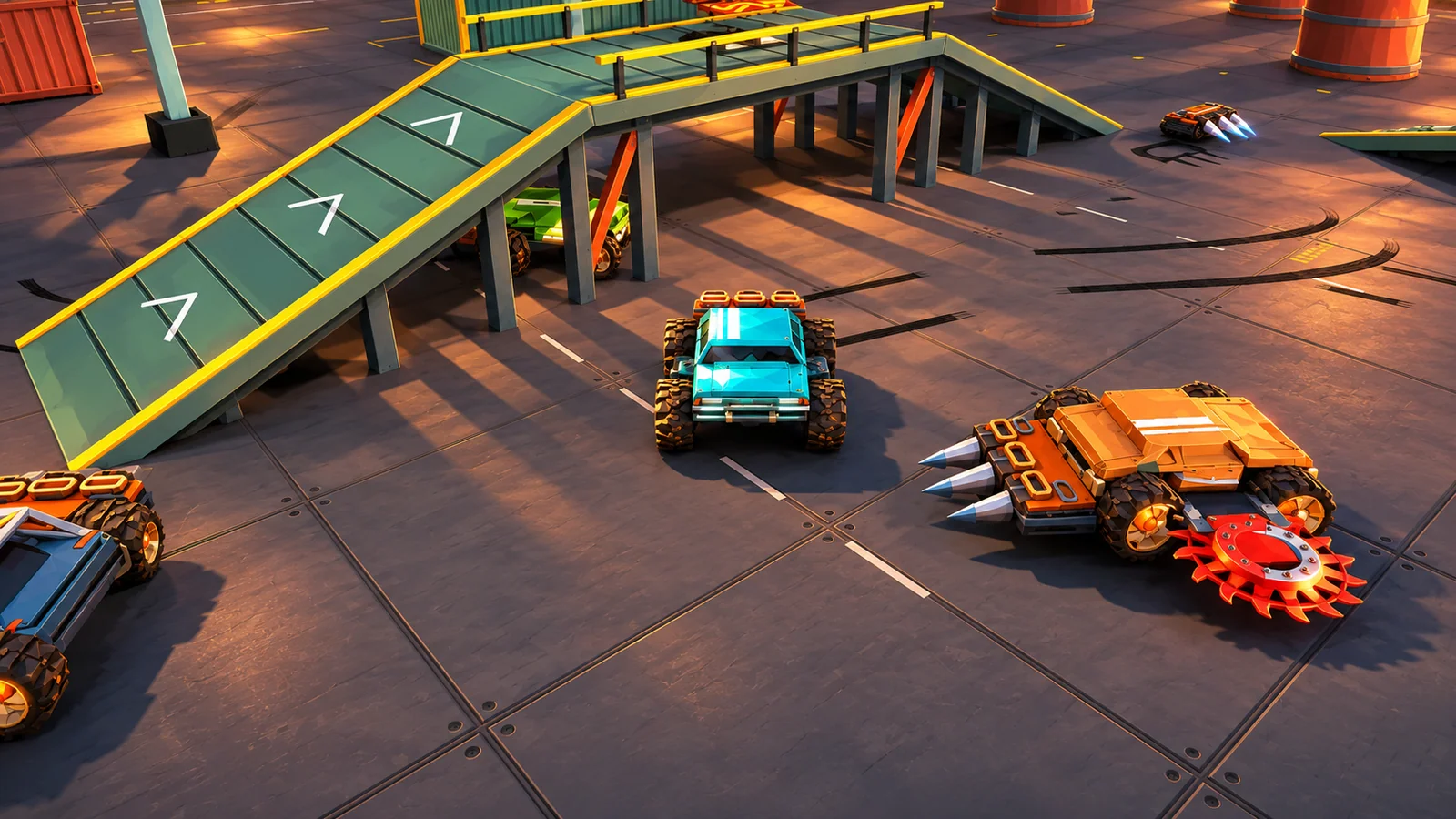
Recognize a flanking driver, an opponent circling with a side saw and a rival breaking off for salvage in an offline heat.
Watch the approach
The seven opponents are local computer drivers. They can collect parts, gain armor and upgrade weapons during the same heat as Tinker. A driver coming toward you may aim ahead of your moving car or take a path to one side. Watch where its nose points over the next car length. An opponent already lined up on the same level may boost to close the last gap.
Look at their fittings
A rival with a saw on a side mount can turn across your path and circle to keep the blade touching. Check which side carries the blade before trying to squeeze past. Against a rival that has just broken away from a collision, keep sight of the exit they chose. Turning instantly back to the impact spot can leave you chasing empty road.
Use the whole field
The drivers also seek nearby salvage, slow for turns and can reverse away from obstructions. A rival that veers toward a gold pickup might be improving a weapon before the next fight. In the meantime, the hull bars under nearby names can show you a more reachable target.
Follow a driver through the opening lap
Pick a name in the standings and find the same name above a moving car. Names such as PocketRivet and Mossbyte come from a pool, so there can be a different field when you start another heat. The name is useful for following one competitor through this particular match. For your first observation, choose a car moving through open ground. Look at its fitted parts and watch it until it changes direction. Where was the nearest other car at that moment? Was there a loose part just ahead? Those two landmarks often explain an abrupt turn more clearly than the driver's position in the standings.
Now watch the same car after it collides. A rival can break away from contact, drive toward a short regrouping point and pick up the chase from another angle. It can also change targets. Continuing to circle the first impact spot assumes it still intends to return there. Follow its nose instead. If the rival is pulling along the outer road while a second driver cuts inward, give the second driver a glance before pursuing the first. You took your eyes off the field to study one opponent, and several others have had time to move into that space.
Recognize a driver aiming ahead of you
Leave the camera at a slight angle on a clear stretch and watch a rival approaching from the side. A driver trying to intercept you can point at a piece of empty road a little way in front of your car. It estimates where you will be from your current movement and updates its steering at short intervals. An opponent aiming there can meet you squarely if you hold course. Make a small adjustment early enough to see whether the other car revises its line. A big turn made at the last instant leaves you with fewer options if another rival is already there.
Some rivals aim to one side of their prediction before they close. A car that seems to be driving past you may be seeking that offset, especially if its nose comes back toward you as the gap narrows. Boost becomes an option for the rival when it is aligned, near enough and roughly at your elevation. A ramp, a support and the approaching rival can all be in nearly the same direction on your screen. Follow the wheels for a moment to see which road the rival is actually using before spending your own boost to counter a charge.
See when salvage becomes the destination
Loose equipment changes traffic. A rival with a suitable pickup nearby can steer for it before it finishes an approach to another car. Watch the gold and cyan dots along the road where your selected driver is heading. Look for the part disappearing and a change to the car as it passes. A new side weapon can change how that rival drives when it next gets close. If the driver takes a pickup you were racing toward, check the lane beyond it. Racing the last few metres to an empty space gives the other car an easy view of your side.
At the upper crossing there is another possible explanation for a turn away from an apparently open target. A driver seeking something above its current level can head toward the bottom of a suitable ramp first. From the ground that movement can look like a retreat. Trace the incline to the deck and check the destination before cutting in front of the car. If you both want upper level salvage, choose between following the ramp and searching for a different pickup on the ground. Cutting straight toward the dot can leave you underneath it with a rival driving off across the deck.
Tell a saw orbit from a recovery turn
A side mounted disc gives a nearby driver a reason to circle. Watch for a rival turning its flank toward your car and maintaining a small gap while the blade comes around. The fitted side matters. A car with its saw on the left wants a different orientation beside you than one carrying a saw on the right. The most useful opening may be the space stretching away from its blade. Turn into that space if it is clear. Trying to match the rival's circle can keep your chassis within reach through several bites while both cars seem to move very little.
A driver reversing beside a wall is doing something different. Rivals sample their movement and can back up, change side and find a new route when they are stuck. If a car is nosed into a support, leave some space behind it as you pass. A stalled car can move into that space quite suddenly. Watch which way it points after reversing before assuming it has resumed an old chase. In a busy corner a third car may block the recovery line, and the fight you thought was ending can start again on the other side of the support.
Use the rivals' choices in a close heat
Distance matters when the drivers pick targets. Recent attackers, a driver's existing target and other rivals already pursuing the same car can influence the decision. Some driving styles also give a little extra attention to a damaged car or one with a good score. These are tendencies you can look for over several encounters. A driver with a particular screen name does not carry a promise to chase you for the whole game. If you break clear while two rivals are facing one another, look back from the next safe straight and see which car each one chose.
Near the end of a heat, use the scoreboard to choose which driver deserves your attention and use the yard to decide whether the attempt is worth making. Suppose the leader turns toward a weapon on a ramp while a damaged rival crosses your level. To reach the leader you would first have to reach a ramp and close the gap. The crossing rival offers a nearer chance to score, but another driver may already be lined up on it. Make the choice with both pieces of information in view. The clock keeps running while all seven local drivers make their own moves.