
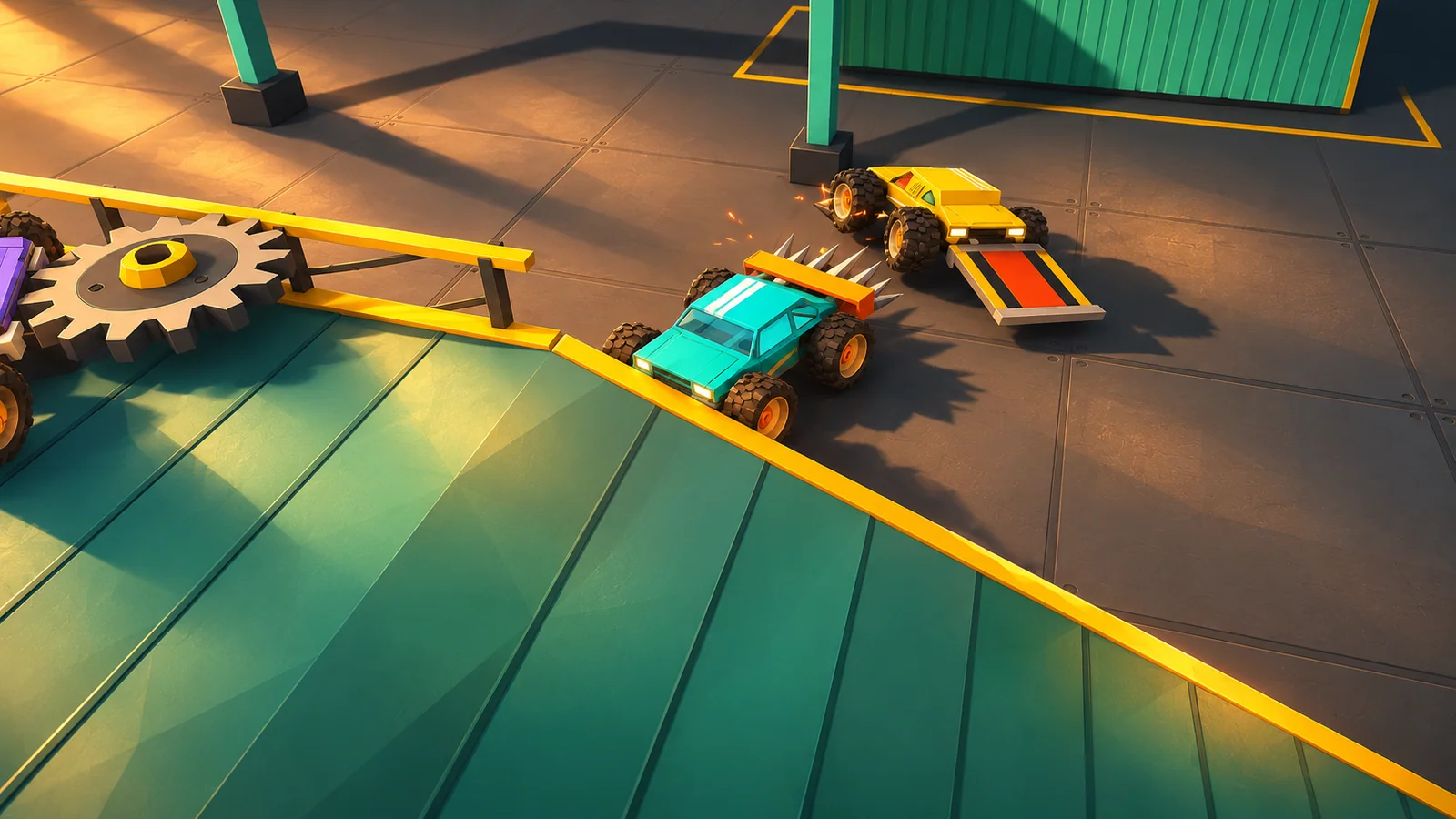
Set up a side pass, hold the blade against one body panel and learn what changes at two, five and ten saw copies.
Match their direction
The disc saw bites repeatedly while its teeth touch the other car’s body. A head-on pass often produces one quick contact as the cars bounce apart. A side mount gives you a longer opportunity. With the saw fitted on the left, pull alongside a rival with their right flank beside your left wheel. Ease the steering to keep the blade there.
Watch for the next bite
The same target can take another saw bite after roughly 0.31 seconds. At two copies each bite becomes stronger, and the fifth copy gives the blade more reach. A wider blade buys a little room on a parallel run, although swerving all the way into the next lane still breaks contact.
Strip a layer at the final tier
At ten copies, three successive bites on the same face strip the opponent’s outer armor layer. Passing from the side panel to the rear starts a new chain for the new face. Follow the rival’s curve with the saw pressed to the same flank. If they spin away, leave space for a fresh approach.
Position the blade before trying to match speed
Look at the fitted car from behind. A disc on Left occupies space outside the left side of the body and needs a clear line into another chassis on that side. Picture two cars traveling side by side. Put Tinker to the right of the chosen rival if the blade is on Tinker’s left. Driving up on the opposite flank can create a convincing scrape between bodies while the spinning part remains in empty air.
Approach from slightly behind and leave a little side clearance until you can see the target’s panel beyond its rear fitting. Then reduce the gap with a small steering adjustment. Charging directly into their side with a burst may secure an initial hit, but it also tends to send the two cars along different paths. For this weapon, a second and third clean contact on the same moving car often repay more than arriving at the earliest possible instant.
Use bite timing to judge a good pass
The saw can bite a particular target again after about 0.31 seconds. That is short enough for repeat hits in a sustained rub but long enough that a fleeting brush may give you only one. Pick an open section where both cars have room to keep moving. Watch the rival’s hull bar across a fraction of a second after the first contact instead of treating any initial reaction as the end of the pass.
Suppose the opponent veers a little away after the first bite. Ease your steering along their new path while keeping the blade on the same side. A sharp turn into their center may move you across the rear panel, or bounce the bodies apart altogether. If the bar stops changing while you can still see the teeth spinning, look for daylight between the edge of the disc and the rival’s body. The visible spin confirms which part is fitted. The loaded blade needs actual contact to do its work.
Read the upgrade milestones from the blade
At two copies the saw does more damage per bite. The contact timing remains important, so extra damage is especially useful in a lane where the cars can stay together. At five copies the blade grows. Its contact radius becomes about thirty percent larger, giving you more reach across the gap. That extra clearance helps you avoid scraping Tinker’s own flank on the opponent while keeping the cutting edge close to the body.
The larger blade also projects outward into scenery. Try the new width in the space between a rival and an open lane before squeezing beside a row of tanks. A lane that barely admits an armored car may have little room for a disc on the outside. When the rival enters such an opening, consider switching to a following route until the passage widens again. You preserve the opportunity for several bites instead of losing all forward motion on a post beside the doorway.
Keep a chain on one face
At ten copies the saw can strip an outer layer with three successive bites on the same face of the same rival. The faces distinguish Left, Right, Front and Rear relative to that rival. If the opponent spins beneath your blade, you might still see contact while the chain moves to a new face. If a second car passes between you, bites on that second car build their own sequence. For a clear test, choose one armored opponent moving steadily along an open road.
Timing matters as well as face. Each bite in the chain briefly keeps the sequence alive, with roughly 0.48 seconds available for the following bite. Normal repeat contact can fit inside this interval. Backing out for a full turn around the tank farm between bites cannot. Once three register in sequence, the stripping effect can remove the outer layer and the count for that target starts again. Check which body the opponent is wearing beforehand to see when that layer comes away.
Use the same saw for different approaches
A front saw can bite while you follow another car closely enough that the blade reaches the rear panel. That setup is useful in a lane where there is space to trail a target but little side room. A side saw is more convenient if the opponent keeps turning in a wide arc. Select the mount when you collect a new saw. If a saw is already installed, another pickup advances the current fitting and cannot be used to put a second blade on the opposite side.
One workable mixed setup leaves the starting rack on the nose and puts the saw on Left. Approach a crossing car with the rack only if the path is clear. As the opponent turns out onto the straight, turn to run alongside on their right. You have a new way to continue the encounter after your first hit has used up the closing speed. If they turn in the other direction, avoid trying to force both weapons to work on one pass. Choose the next approach according to the side that is available.
Recognize when to release the rival
Hull loss is limited during a short burst of incoming damage. Several cars crowding the same opponent can make its bar behave differently from what you saw in a quiet one-on-one pass. Near the bridge entrance, look ahead of the target as well as at its remaining hull. If the group is about to meet a railing, steer toward the clear side early enough to leave with the blade intact and the car moving.
A useful drill is to mark the start and end of one sustained contact mentally. Which side was the saw on, which face did you reach first, and what actually separated the cars? If it was a change of speed, begin the next pass with less of a rush. If the rival spun, plan for a shorter first contact and a fresh approach. If scenery caught the saw, choose another road. Each explanation leads to a different correction you can try within the same three-minute heat.
Bring the blade back after a wreck
If you lose a nine-copy saw, the next loose saw takes your retained count to ten and fits the armor-stripping version. Choose the mount for that pickup on the way over. A final-tier saw on your familiar side is easier to use immediately than one fitted on an unexpected flank.