
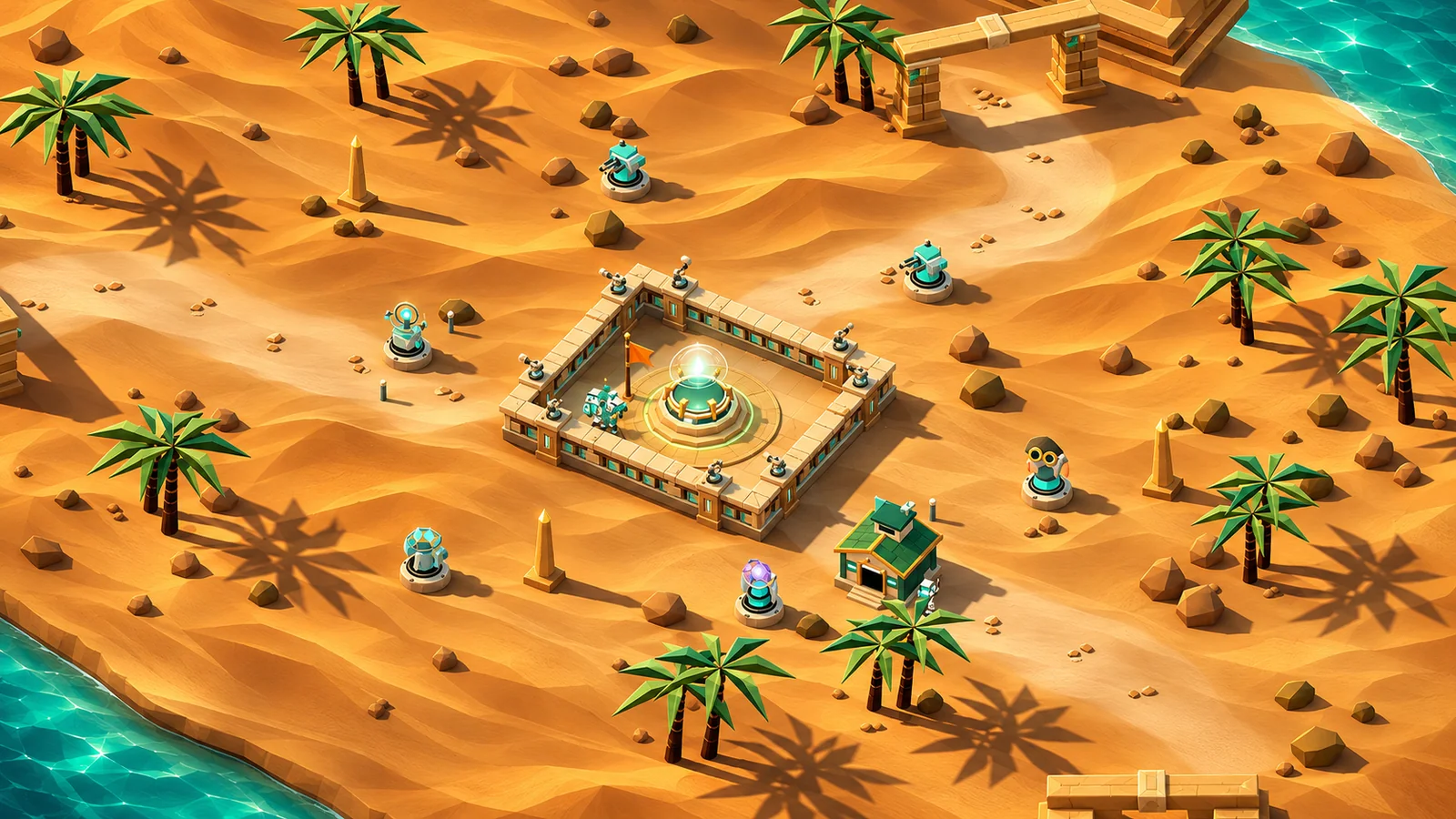
Read Verdant’s desert still through the shadows of a palm, an obelisk and the sandstone gateway.
Identify the object from its shadow
Look at the dark star on the sand to the right of the palm in the lower left of Sundune Expanse. Its points belong to individual fronds. A short dark line joins them to the trunk, so the shadow almost gives you a second drawing of the tree. Compare it with the obelisk along the lower edge of the fort. The obelisk throws a clean, narrow wedge across the ground.
Both shadows stretch generally to the right. Once you see that common direction, the objects stand up from the sand even in the small gallery view.
Look through the gate
The stone gateway at the upper right casts a broad shadow with a patch of sunlight between its supports. Trace the pale trail through that opening toward the outpost. It becomes easier to see which bands on the ground are pieces of road and which are shadows cast across the road.
One last detail is worth enlarging. Small rocks leave dark marks very close to their bases, while the nearby palms cast leaf shapes well away from their trunks. The distance across the ground gives a clue to height long before you try to judge the sizes of the objects themselves.
Choose a palm with room around it
The single palm low on the left is an unusually clean example because there is plenty of exposed sand on one side. Start at its base and follow the thin dark trunk shape across the ground. It ends in a much wider patch with recognisable leaf tips. Work back from one of those tips to the crown drawn above. The two shapes are related, but you cannot lay one neatly on top of the other. The leaves spread out at different angles in the air, and the sand below slopes and folds. Both surfaces affect the shape you see on the ground.
The nearby group of palms at the lower edge is a harder puzzle. Their crowns overlap and their shadows stretch near one another. Pick one trunk and keep a fingertip at its base as you trace. When the shape becomes ambiguous, return to that starting point and try another edge. This is much easier than trying to divide a patch of shade into individual star shapes. The same method works on the little cluster of palms near the far gate, where several dark trunks stand against the sunlit face of the masonry.
Read the sand before the shadow
Look at the broad area above and to the left of the outpost. The ochre changes shade along large straight and gently angled lines. Follow one of those lines and it runs up onto a low ridge, bends across a broad plane and sometimes meets another at a shallow point. These changes describe the folds in the sandy ground. A pebble standing on one of those planes has a quite different edge. You can trace its compact perimeter and then watch a smaller area of shade reach away from it.
An effective way to sort these marks in a drawing is to give them different kinds of pencil strokes. Draw the long folds of sand with the side of the lead. Then work in the rocks and their short dark marks with the point. Look back at the still whenever a ground fold starts to resemble the edge of a very large shadow. Does the darkening follow a change in the shape of the dune? Can you find an object at one end that would cast it? Those questions catch several easy mistakes in the patch of desert directly above the fort, where stones sit right over changes in the colour of the sand.
Measure from the same end
For a comparison of heights, choose the tall obelisk just below and left of the outpost and one small rock nearby. Put a finger at the point where each object meets the ground. Follow the patch of darkness out from there. That starting point matters. If you start at the bright tip of the obelisk instead, your estimate mixes together the height of the object as it appears in the image and the length of the mark on the ground. The little square base gives you a convenient, visible place to take the measurement.
A second obelisk stands toward the right, near a palm and a turret. A third rises above and left of the fort. Compare their footprints as well as their dark wedges. All three have broad square bottoms, a narrow shaft and a light tip. They make better comparative subjects than a palm and a rock because their outlines have much the same shape. Even so, the still gives only an angled view of uneven ground. The apparent lengths can suggest which object is taller or where a slope catches the light. They cannot yield a dependable scale in metres. A sketch can preserve that useful uncertainty simply by keeping the measurements on the page.
Look beneath the architecture
The gate across the upper right is built from square pillars and a horizontal lintel. Blocks stick out slightly at the bases of the pillars. In the opening you can see sand and the pale path continuing beyond. The darkest part of the shadow below the lintel nearly connects the feet of the supports. Farther away the shape spreads across the ground as a broader bar. Sketch the opening and the strip of shade immediately below it together. Capturing both makes the stone beam look convincingly raised above the path even in a tiny drawing.
Now inspect the wall around the Heart. Its near corner is easy to identify by the small rectangular inlays running down its vertical face. There is a broad patch of shade immediately outside that corner, and a separate, narrower area of shade on the ground inside the courtyard. Within the enclosure, the flagpole, the central machine and the little figure also interrupt the light. This is a good place to compare two scales of shadow at once. The larger boundary explains where the wall stands. The finer marks help you see the small things as objects occupying its courtyard.
Keep a little sunlight in the drawing
Imagine reducing the whole desert image to cream paper and one brown pencil. Which areas would you leave alone? The light winding track leading to the gateway is one candidate. So is the sand between the single left palm and the nearest turquoise tower. These open areas let the dark shapes retain separate identities. If you fill them all with marks for grains of sand, the edge of a shadow becomes much harder to follow. The illustration uses only a scattering of stones and sharp accents in several of the broadest patches of ground.
There is an especially instructive pair of corners in this picture. At the lower left and upper right, turquoise water touches the diagonal edge of the desert. Both corners contain bright lines and small glittering marks, but neither carries the recognisable silhouette of a tree crown that you saw inland. Keep those water marks light and the palm shadows dark in your sketch. When you look at it again the next day, you may find you can still name the materials from those few differences. The strongest clue to a sunlit desert in this image is the shape of an ordinary patch of shade.
If you shade only one palm on your finished sketch, choose the one with a clear patch of ground beside it. Its separate crown and projected leaf tips give you the fullest pair of shapes to compare.