
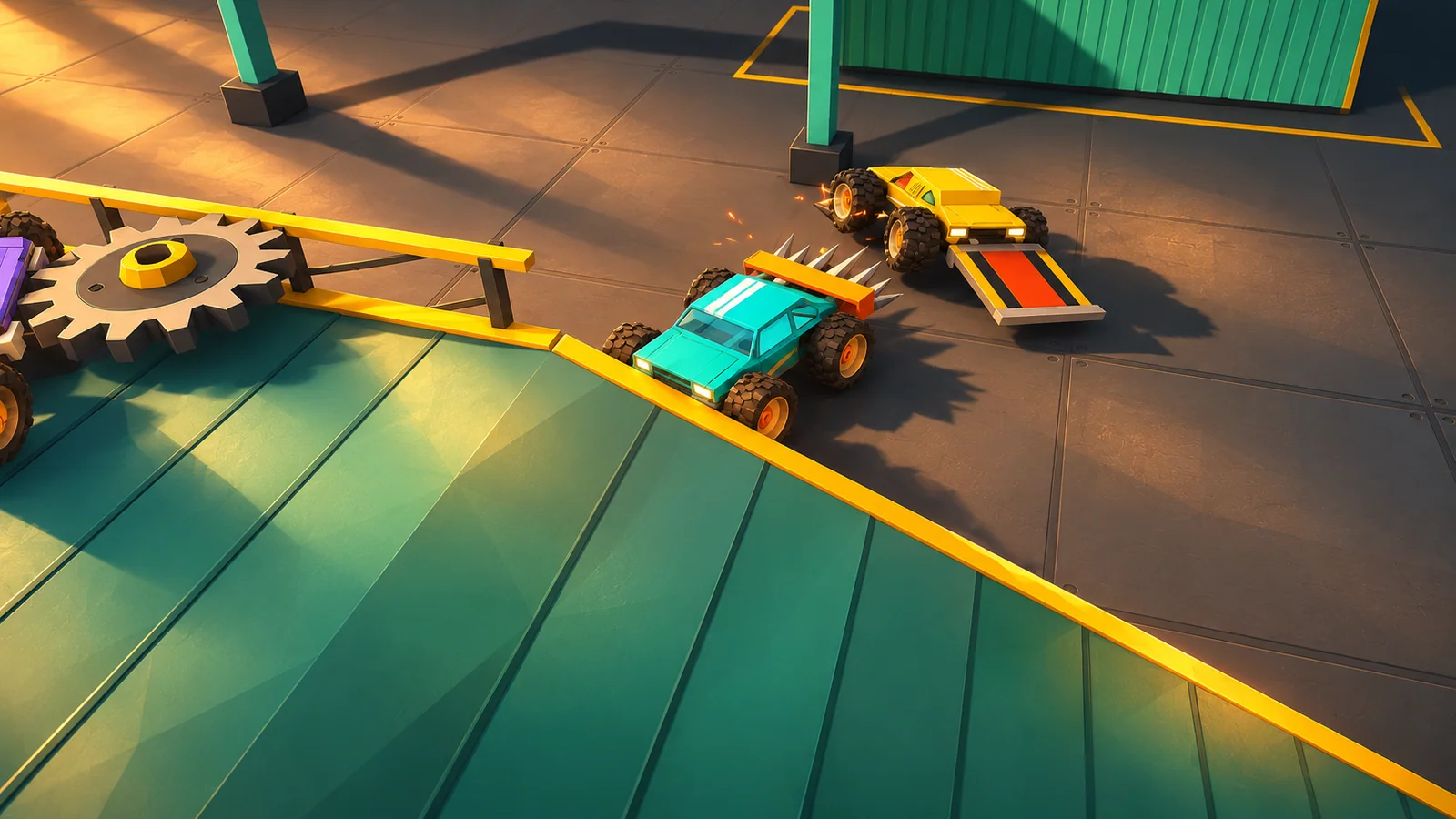
Meet a crossing rival with your nose, interpret the Broadside and Clash captions and choose a clear way out after the impact.
Look for a crossing
A broadside is a body ram into the flank of a rival. Side panels take more ram damage than the nose or rear under comparable conditions. Look across the end of a container row for a driver about to emerge. Aim a little beyond the corner so your nose meets the side as the other driver clears cover. A direct chase from behind offers a different impact angle.
Watch what actually touches
The cars need closing speed for a ram. Gliding alongside at the same pace gives little impact, even if both cars are moving quickly. Interlocking attachments can throw the cars apart and show Clash. That contact alone causes no hull damage. A Broadside caption tells you the collision geometry reached the side, while the opponent’s hull bar helps you judge its effect.
Leave a runout
Choose a pass that takes you back onto open road if the rival moves early. Boosting straight toward a container wall gives you little margin for a miss. The crossing at the end of the row gives you the same side-on opportunity with space to turn back.
Look for the long side of the other car
On a straight, the easiest part of a rival to see is often its rear. Following directly behind gives you a clear target but very little side to hit. Watch instead for a driver already turning across an opening. As it turns you can see the distance between its front and rear wheels. That long side is the surface you want for a broadside. Aim for the point where the body will cross the road. If you aim at the rear wheel where it is now, the rest of the car may have disappeared through the opening before your nose reaches it.
A useful observation spot is the end of a row of containers. From a little way back, you can see whether a rival rounding the end is continuing away or turning across your lane. Approach at normal speed first. Leave room beyond the crossing so a missed pass takes you onto open road. A gap that ends against a support may offer a beautiful view of the other car's side and still be a poor choice. A broadside attempt lasts a moment. Recovering from a miss against scenery can occupy enough of the heat for the rest of the field to change places.
Judge how quickly the gap is closing
Two cars moving very fast in the same direction can spend a surprising amount of time side by side. Their speed along the road tells you little about how hard they are coming together. The game looks at how quickly the space between them closes along the line of impact. Drifting gently into the next lane gives a different result from crossing it while another driver travels through the intersection. This is also why a parked or turning car at the mouth of a lane can present a better opportunity than a fast car with a large stretch of clear road behind it.
Normal throttle takes the car toward 7.8 metres per second, and boost raises the target to 15.2. Those figures describe what the car is trying to reach. Tapping boost as your bumper touches another car leaves very little distance to build speed. Pick a visible crossing point, line up first and use the open approach to gather speed if you choose to boost. Watch for a change in the rival's heading during that approach. A driver turning its nose toward you can transform a side opportunity into a head on meeting. Keep the option of driving past while the gap is still wide.
Work out which parts actually met
In a clean body ram the direction of each chassis matters. For otherwise comparable hits, the side of a car is more vulnerable than the rear, and the nose takes the smallest multiplier. This describes one part of the calculation. The mass of both cars, their incoming motion, armor and recent damage also affect the outcome. A broadside caption identifies the geometry of the contact. It does not promise a knockout or mean the attacking car escaped unharmed. Look at the rival's remaining hull after the cars separate before deciding what another approach to that same driver might be worth.
Some of the most convincing looking near misses happen when the two weapon models meet first. The game can shove both cars apart while the chassis stay clear. Look for the clash caption. If you are repeatedly catching a rival's projecting saw, try approaching from a position that would put your front closer to its bare side. Check the height as well. A rival rolling over the central crossing can look directly in your path when you are on the road underneath. Follow the two cars to the same level before spending boost on an approach that only lines up on the radar.
Recover from a miss without giving away your side
Decide where to go after the pass before your rival enters the gap. One option is to continue along the outer road and look back with the camera once the lane is clear. Another is to take a gradual turn beyond the crossing so you see the steadiest driver leaving the fight. An immediate turn across the impact point leaves your own flank in the lane you just crossed. Against seven rivals, the driver who catches you there may have had nothing to do with the original encounter. Look through the exit for that second car before choosing to turn back.
After a successful hit the opponent may spin or move sideways, particularly after a side impact. Let the new motion settle enough to tell which part of the car you are looking at. A second push against the same spot on the screen can hit its nose or a weapon once the body has rotated. If your own car has spun, recenter the view in open space and rebuild the approach from the next turn. The short trip around a container can give you a cleaner side view than trying to keep your front pressed against a car that is already sliding away.
Choose a pass that serves the score
A broadside is a way to damage a rival during a scoring opportunity. The point arrives with a knockout. A driver with plenty of armor might soak up a well placed hit and leave with most of its hull. A nearby rival with exposed hull could be a better use of the same opening, especially near the end of the heat. Check the standings when your lane is clear. A knockout on the sole leader earns two once that driver has at least two points. A tie for first changes that calculation, even when the same familiar name stays at the top of the list.
To practice, separate the choices across a few passes. Spend one pass identifying a car that will turn across your lane and let it go. Use the next to arrive at a crossing at ordinary speed with an open exit. Once you can see the long side early enough, add boost to an approach with room and compare the contact caption and the two cars' positions afterward. If the rival changes direction midway through, keep driving toward your exit and try another turn. The skill worth repeating is recognizing a crossing you can use in time to make a choice about it.